NEW - ISO 27001 Certification and ONNX and Triton Blueprints for Accelerated Inference
Share insights, seek advice, or simply connect with fellow members on topics that matter to you.
Recently active
With the proliferation of chatbots and agents, users are rushing to learn more about the technology. The speed with which GenAI is growing is fueled by the data with which the AI has access to. Chatbots are curating a combination of synthetic and user based content to collect questions, data, chain of thought, and context.Do you believe sharing your data and logic online with AI means giving up rights to your IP?
The rapid evolution of Large Language Models (LLMs) has ushered in a new era of AI-powered chat assistants, leveraging techniques like supervised instruction fine-tuning and reinforcement learning with human feedback (RLHF) to enhance their instruction-following and conversational abilities. These advancements have led to models that are increasingly aligned with human preferences, often outperforming their unaligned predecessors in user satisfaction. However, this progress has brought forth a significant challenge: how to effectively evaluate these sophisticated models. Traditional benchmarks, which typically focus on core capabilities such as knowledge retrieval and problem-solving, fall short in assessing how well these models align with human preferences in real-world applications. We've observed instances where models excel in benchmark tests yet underperform in practical scenarios that demand alignment with human expectations.While human ratings remain the gold standard for eval
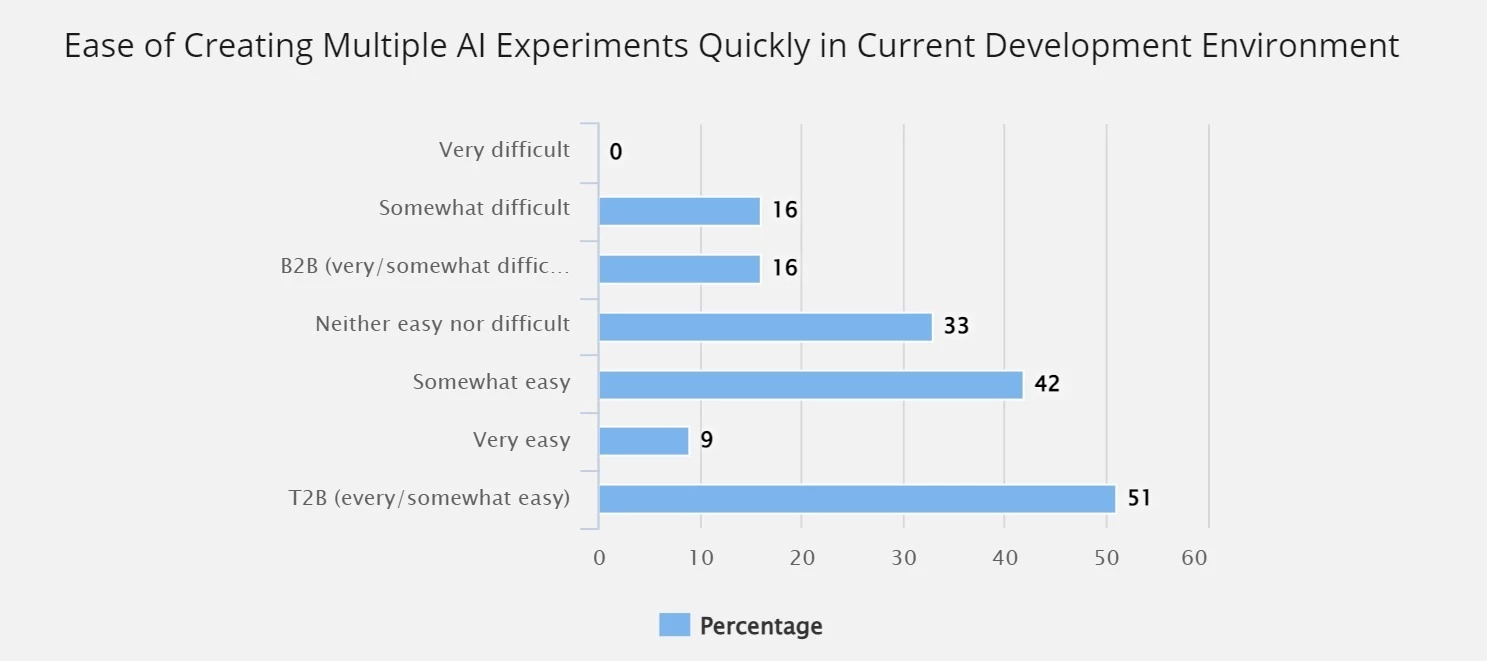
In Part 2 of our survey, we dive into data scientists’ needs for collaboration and scalability in AI platforms. While many find creating multiple experiments manageable, nearly half feel neutral or challenged by the process, signaling room for improvement. Data scientists emphasize the importance of platforms that offer easy deployment, scalability, user-friendly design, seamless integration, and strong security.Most collaboration happens through shared platforms for project management and file sharing, with team communication blending in-person meetings and digital messaging. Moving forward, platform development should prioritize ease of collaboration, integration, security, and scalability. Additionally, aligning with data scientists' success metrics—like accuracy, ROI, and user satisfaction—will help highlight platform benefits effectively.
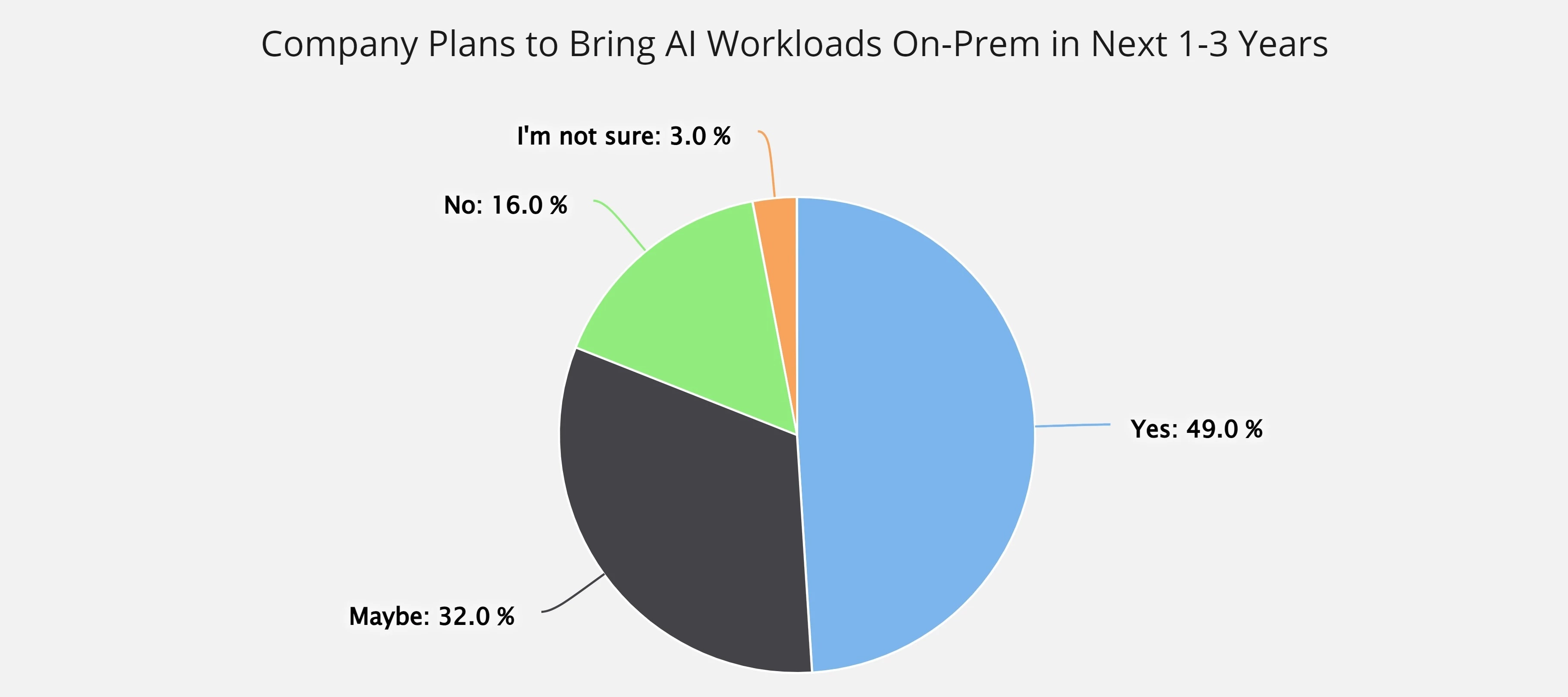
In our recent survey of over 65 data scientists, we set out to understand the perceived value of AI development and uncover the moments when users experience that crucial ‘aha’ feeling with AI/ML platforms. Knowing when users recognize value within the development lifecycle helps us shape better tools and support.A key takeaway? With the majority of organizations planning to bring AI workloads on-premises within the next few years, security and privacy are top of mind for data scientists when running AI/ML workloads locally.Here's what we found:81% of organizations have firm or potential plans to bring AI workloads on-premises within the next 1-3 years.Over 70% of respondents rated security and privacy as very important when it comes to the ability to run AI/ML workloads locally.Stay tuned for Part 2 of our survey insights, where we’ll dive into what data scientists are looking for in terms of collaboration and scalability. Beyond just easy deployment and experiment creation, they’re s
Hello Community Members!October has been an eventful month, filled with engaging activities, insightful news, and exciting events. Let's take a look back at the highlights, dive into our latest webinar recap, and learn how you can contribute your ideas to Boost and AI Studio initiatives. Here’s your October community recap!🎤 Last Webinar RecapZ by HP Boost Webinar On October 4th, we hosted a highly informative webinar focused on maximizing on-premise compute power for AI and ML model training. Akash James demonstrated how he leverages remote GPU access from the Himalayas to work on his multi-modal LLM project, VERONICA. His presentation not only highlighted innovative techniques but also inspired many attendees to explore remote compute solutions for their own AI projects. 🗞️ Latest NewsGartner’s AI PC Shipment Forecast A Gartner report predicts that AI-powered PC shipments will surge by 165.5% by 2025. This forecast has initiated discussions in our community about the future of AI
Gartner projects that AI-powered PCs will hit 114 million units in 2025, marking a massive 165.5% jump from 2024. These AI PCs, defined by their built-in neural processing units (NPUs), include models running on Windows, macOS, and Arm-based systems.By 2024, shipments are expected to reach 43 million units, nearly double the 2023 total. Laptops lead the way, with AI-enabled models predicted to make up 51% of all laptop shipments by 2025, outpacing desktops.Gartner forecasts AI PC shipments to reach 43 million units in 2024, a 99.8% increase from 2023.AI PC Shipments, Worldwide, 2023-2025 (Thousands of Units) 2023 Shipments 2024 Shipments 2025 Shipments AI Laptops 20,136 40,520 102,421 AI Desktops 1,396 2,507 11,804 AI PC Units Total 21,532 43,027 114,225 With nearly half of all PCs integrating AI by 2025, what industries or activities do you think wi
Stanford University research team explores gain cell memory technology to address the limitations of current SRAM and DRAM memory in GPUs. By combining features of both SRAM and DRAM, the goal is to speed up data access and reduce power consumption.Top Three Takeaways:Gain Cell Memory: hybrid gain cells combine the speed of SRAM with the capacity of DRAM, to overcome the memory wall problem in GPUs by reducing data transfer delays. Innovative Materials: combining different materials for transistors (ALD ITO FET and Si PMOS), the hybrid gain cells provide faster data access, non-destructive reads, and significantly longer data retention compared than traditional DRAM. Potential for SoC Applications: can serve as a drop-in replacement for SRAM, offering higher capacity at lower fabrication costs, making it attractive for SoC manufacturers in datacenter GPUs, CPUs, and embedded systems.Check out Chris Mellor article on Blocks & Files: “Stanford team proposes hybrid gain cell memory to
As a Z by HP Ambassadors, Benedict Neo was equipped with the HP Z6 G5 Tower Workstation, featuring an AMD Ryzen Threadripper PRO 7965WX processor and NVIDIA RTX 6000 graphics. This powerful setup is tailored to significantly enhance his data science projects. However, a new workstation means he needed to establish a fresh data science environment.Here’s a walkthrough into how he configured his workstation, along with valuable tips to help you optimize your own setup for maximum efficiency. In this setup, Benedict walks you through installing PowerShell 7, WSL, Ubuntu, Git, setting up CUDA, and installing Python with Mamba.How to Setup Windows for Data Science HP Z6 G5 SpecsProcessor: AMD Ryzen Threadripper PRO 7965WX 24-Cores 4.20 GHz Installed RAM: 256 GB (255 GB usable) System type: 64-bit operating system, x64-based processor Graphics: NVIDIA RTX 6000 Ada 48 GB 4DP Graphics
As we wrap up September 2024, we're thrilled to spotlight standout stories, articles, and posts from our vibrant community. Celebrating Our Z by HP Ambassador of the Month: Javier Eluney Hernández 🎉 We were thrilled to honor Javier Eluney Hernández as our very first ever Z by HP Ambassador of the Month. Javier has significantly advanced AI research, particularly in Computer Vision and Generative AI applications within healthcare.With a sustained passion for exploring the frontiers of machine learning, Javier's work spans computer vision, AI in healthcare, and natural language processing. His notable projects include the Medical QA LLM, aimed at providing accurate, context-aware answers to medical inquiries. Javier currently holds the position of Data Engineer II at Brookfield Renewable U.S.. Webinar Announcement: Z by HP Boost Z by HP Boost brings enhanced performance to your data science teams by offering instance access to idle GPU resources. Don't miss our exclusive webinar on Oct
With the wrap-up of HP Imagine yesterday, AI and remote work took center stage in every new product announcement. One key highlight was the introduction of Z by HP Boost, a solution that enables teams to share on-demand GPU power from their combined fleet of local workstations. Additionally, HP is expanding AI Studio to strengthening LLM development with a “built-in layer of trust” by protecting against hallucinations and bias.HP also announced several exciting AI-powered PC, audio, and visual products, including the new HyperX Cloud MIX™ 2 headset, Poly Labs, and the HP OmniBook Ultra Flip 2-in-1 Laptop Next Gen AI PC, to name a few that will elevate both work and play experiences.🎉 Overall, these are exciting strides in AI for HP, coming in November 2024 and the first quarter of 2025.Check out the full press release here: HP Transforms the Future of Work | HP® Official Site
This week Anbu Valluvan Devadasan et all published a paper titled “E-SMOTE: Entropy Based Minority Oversampling for Heart Failure and AIDS Clinical Trails Analysis.”I reached out to Anbu to chat about the Entropy-based Synthetic Minority Oversampling Technique (SMOTE) which uses a subset of the dataset from the minority class to address overbias of a majority class. Anbu explained that the team used entropy as a metric to assess influence of a minority class on outcomes and outperform conventional SMOTE oversampling techniques in some cases. Results illustrated that both SMOTE and E-SMOTE techniques should be considered for addressing imbalanced data samples as they can be used to address class imbalance. Anbu is excited and looking forward to dig deeper into which data characteristics affect metrics and how.Anbu’s open to chat about his work. If you’re interested, ping him - linkedin.com/in/anbuvalluvan. S. Veerla, A. V. Devadasan, M. Masum, M. Chowdhury and H. Shahriar, "E-SMOTE: Ent
NVIDIA is currently offering a selection of free courses through its Deep Learning Institute, each designed to boost your AI and Data Science skills.Here are a few highlights: Building RAG Agents with LLMs: Dive into the practical aspects of deploying RAG (Retrieval-Augmented Generation) agent systems. Learn how to connect external files, like PDFs, to large language models (LLMs) for enhanced functionality. Generative AI Explained: This no-code course provides an accessible introduction to Generative AI. Explore its concepts, applications, challenges, and opportunities, making it perfect for newcomers to the field. Accelerate Data Science Workflows with Zero Code Changes: Across industries, modern data science requires large amounts of data to be processed quickly and efficiently. These workloads need to be accelerated to ensure prompt results and increase overall productivity. NVIDIA RAPIDS offers a seamless experience to enable GPU-acceleration for many existing data science tas
Hello everyone!I just created a blog post about exploring current Medical LLMs. If you are interested about AI in Healthcare and GenAI, and would like to learn how to create demos with Python and Gradio, I invite you to read it! https://medium.com/@miracfence/exploring-fine-tuned-medical-llms-cbb42dd4911f
According to Gartner, by 2027, 40% of generative AI (GenAI) solutions will feature multimodal capabilities—encompassing text, images, audio, and video—up from just 1% in 2023. This transition from single-modal to multimodal models promises to improve human-AI interactions and create unique opportunities for differentiated GenAI-powered products and services.The Rise of Multimodal GenAIMultimodal Generative AI is set to revolutionize enterprise applications by introducing innovative features and capabilities previously unattainable. Its influence spans across various industries and applications, enhancing interactions at every point where AI meets human engagement. Currently, many multimodal models incorporate only two or three modalities, but this is expected to expand significantly in the coming years.Open-Source LLMsOpen-source large language models (LLMs) are transforming enterprise value by democratizing access to advanced generative AI. They enable businesses to tailor models for
As it is already well-known, for the last couple of years companies have been using AI in films in order to optimize multiple processes, from computer graphics, to animation, etc. Today, however, we can see it being hugely involved in the process, even in the whole automation of creating a film. For some artists, this may be a huge concern, for others it MAY be an opportunity to explore their creativity. In posts and programs like this https://runwayml.com/news/runway-partners-with-tribeca-festival we can see the potential in GenAI applications in the film industry, as long as the latest research https://runwayml.com/research/introducing-gen-3-alpha What do you think that are the actual limits of this? Do you think it will eventually ceil and just become one more tool for humans to explore their own creativity? Or, do you think it will become something like that one Black Mirror’s episode “Joan is Awful” where content is being automatically generated without any restrictions, just for
Some years ago, one of the things that was hyped in the AI Community but that I still think has huge relevance for the future in AI is Federated Learning and Privacy Preserving Machine Learning (PPML). This comes from an idea that future devices will have more than enough power to run the majority of our biggest models, or that models will be efficient enough to run on them. This without losing the aspect of keeping our data private and secure.What do you think about this? Do you think this is where AI Development would head eventually? What others directions could be the most feasible and with the most usage our future? A couple of those that come to my mind are Embodied AI and Causal Machine Learning.
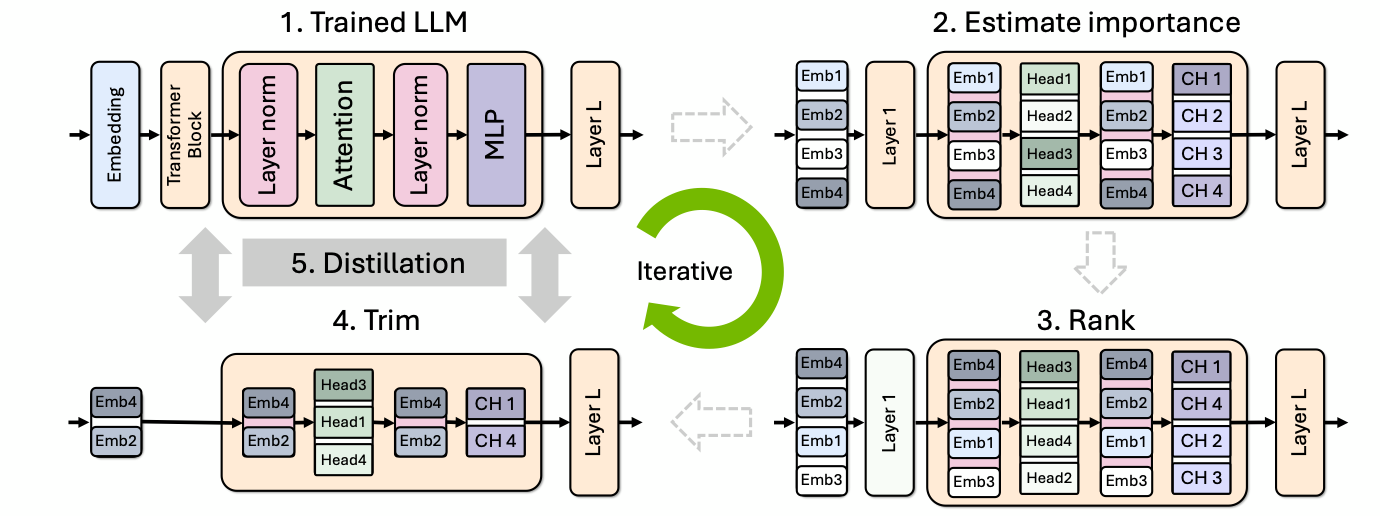
As we wrap up August 2024, we’re excited to highlight some of the most insightful articles and posts shared by our vibrant community. Dive into these expert opinions, groundbreaking research, and practical guides to stay ahead in the AI and data science fields.AI Trends in Data ScienceDelve into the "AI Trends in Data Science" report, brought to you by NVIDIA and our community of 800 data scientists. This report covers the latest trends, key adoption barriers, and emerging opportunities. Enhance your AI strategy by exploring these unique insights. Check out the full report here. Optimizing Language Models with NVIDIANVIDIA's research team has developed an innovative approach to creating smaller, highly accurate language models using structured weight pruning and knowledge distillation. This breakthrough reduces training time, costs, and improves model performance. Learn about how this technique was applied to the Llama-3.1-Minitron 4B model here.Webinar: AI Studio Live Demo RecapOur fi
NVIDIA's research team has introduced an innovative approach to developing smaller, yet highly accurate language models by leveraging structured weight pruning and knowledge distillation. These techniques are designed to streamline the model without compromising its performance, offering several key benefits for developers and organizations focused on AI development.Key Benefits and Innovations: Performance Improvement: The refined models achieve a 16% improvement in MMLU (Massively Multilingual Language Understanding) scores. MMLU is a benchmark used to evaluate a model's understanding and processing of multilingual content, making this improvement significant for applications that require high linguistic accuracy across different languages. Training Efficiency: The method reduces the number of tokens required to train new models by a factor of 40. Tokens are the building blocks of language models, and reducing their number drastically cuts down on computational resources and time n
HP Data Science Ambassador Akash James uses a zero-shot approach to create Veronica to be aware of her spatial surroundings through visual, audio, and text interactions to describe what she sees. Check out his LinkedIn post to see a demo of how it works…
OpenAI announced the launch of fine-tuning for GPT-4o, addressing one of the most frequently requested features from developers. This new capability allows developers to fine-tune the GPT-4o model with custom datasets, enhancing performance while reducing costs for specific applications.To support the rollout, OpenAI is offering 1 million free training tokens per day for every organization through September 23. This incentive is designed to help developers explore fine-tuning without immediate cost concerns.Developers can begin fine-tuning by visiting the fine-tuning dashboard. The process involves:Accessing the dashboard. Clicking "Create" to start a new project. Selecting gpt-4o-2024-08-06 from the base model options.GPT-4o Mini Also AvailableOpenAI also offers GPT-4o Mini for fine-tuning. This smaller model is available with 2 million free training tokens per day until September 23. To use it, developers should select gpt-4o-mini-2024-07-18 on the fine-tuning dashboard.Data Privacy
Maikel Ronnau et al will publish Automatic segmentation and classification of Papanicolaou-stained cells and dataset for oral cancer detection in next month’s Computers in Biology and Medicine.Their research uses a CNN U-Net architecture with ResNet encoder to achieve expert level performance by segmenting and classifying a trained on UFSC OCPap dataset of oral cytology images. The team uses transfer learning for image segmentation to train the model which is used to evaluate more than 1500 images from 52 patients labeled by specialists resulting in an average Dice score of 0.66 and Intersection over Union (IoU) of 0.65. “The CNN model architecture for encoding layers are based on DenseNet-169 while the decoding layers are LinkNet but to replace the regular softmax layer with a temperature scaling softmax with a temperature parameter value of 0.1 to increase the confidence of the predictions and avoid the bias towards the prediction of background pixels. The model’s prediction is furth
GPU availability and job interruption can be an issue for me, so this paper caught my attention. The paper is titled “Mirage: Towards Low-interruption Services on Batch GPU Clusters with Reinforcement Learning” and it proposes a method for reducing service interruptions on GPU clusters for deep learning jobs.The tool is called Mirage. Mirage is a Slurm-compatible foundational model that uses statistical and reinforcement learning (RL) techniques to proactively provision resources to mitigate interruptions. To accomplish this, researchers alter the decoder transformer architecture to create a Mixture of Experts (MoE) of neural networks. The neural networks share the same network architecture to support scaling up of model capacity and determine ‘best-fit experts’ that optimize job trace analysis outputs for resource allocations. What’s really cool about this paper is how it investigates the use of Deep Q-Learning RL techniques to reenforce rewards to improve GPU queue wait times for a f
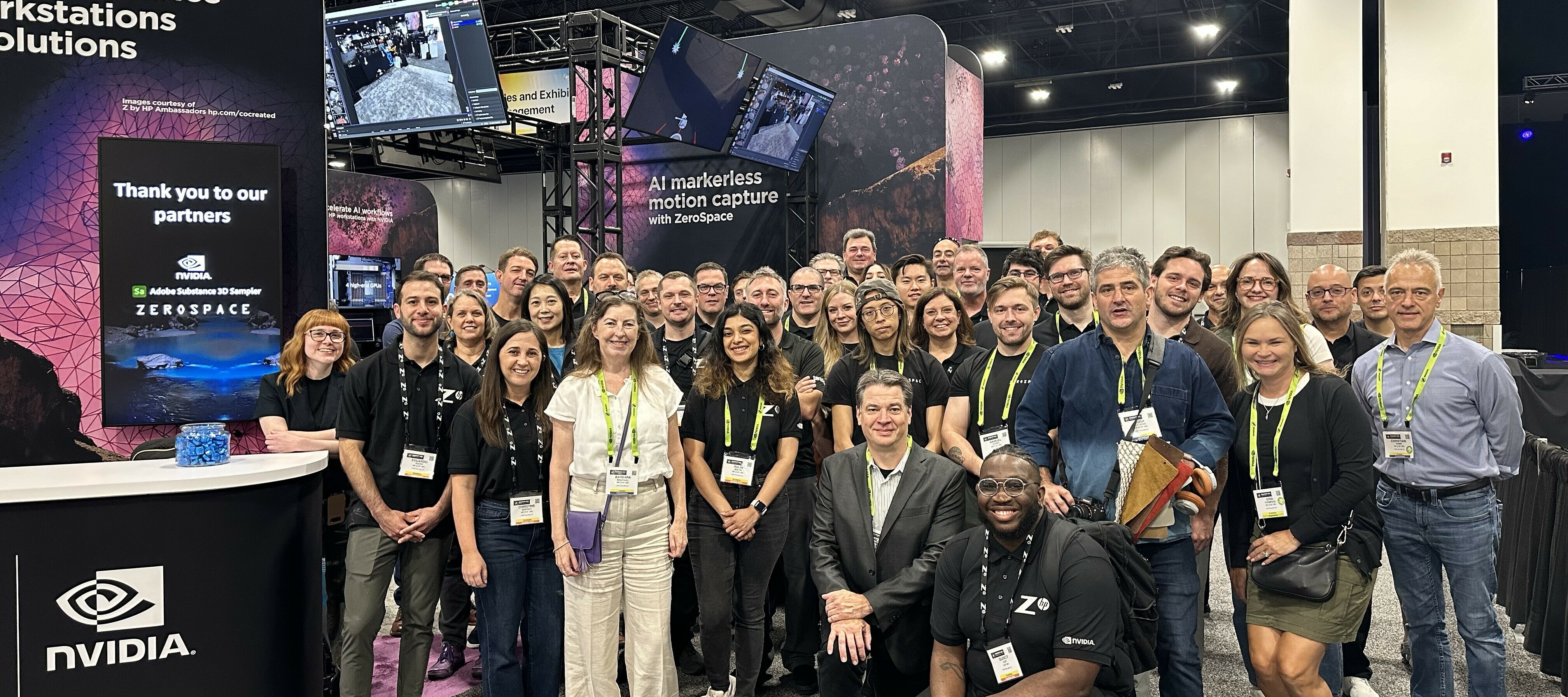
Check out the scene at the Z by HP booth at Siggraph 2024. At our booth, you'll discover the latest advancements in AI workstations and live demonstrations of AI Studio in collaboration with our partners, NVIDIA and Zerospace.What is Siggraph?ACM SIGGRAPH is a special interest group within ACM, and SIGGRAPH 2024 is the premier conference on computer graphics and interactive techniques worldwide.
We’re excited to bring together Data Scientists and IT Decision Makers (ITDMs) to explore the landscape of model hubs and compute systems. Our focus is on understanding the preferred model hubs that Data Scientists use for accessing pretrained models, as well as the compute systems they rely on for AI development and creation. As our research progresses, we’re eager to share some preliminary insights with you. Here’s an update on our early findings:Model Hubs (DS only)Data scientists most commonly use platforms such as Microsoft AI GitHub, Google Model Garden, AWS Model Zoo, and PyTorch Hub. Hugging Face 25% Tensorflow Hub 19% Pytorch Hub 31% Microsoft AI GitHub 38% Model Zoo by OpenAI 6% ONNX Model Zoo 6% NVIDIA NGC 6% Google Model Garden 38% AWS Model Zoo 31% TorchVision Model Zoo 13% Qualcom AI Hub 6% Model Zoo for Int
At last month's Figma annual conference, Config, several new features were unveiled, including Figma AI. Designers like me have been eagerly awaiting updates from the collaborative design tool giant, especially after their deal with Adobe fell through. The question now is: how will Figma lead the way for creatives to design with AI as a supportive tool? How will it be different from what we’ve seen from existing tools?The new features are impressive. They include a text translation feature to visualize product designs in different languages and Figma Slides, a natural business and feature decision for Figma as designers are already presenting in Figma or creating slide decks rather than migrating to Google Slides or PowerPoint, as can be seen from the Figma Community templates available. Additionally, a redesign of Dev Mode allows developers to focus on details like new published updates.The most significant feature is Figma AI, where users can click a button to "Make a design," enter
Already have an account? Login
Enter your E-mail address. We'll send you an e-mail with instructions to reset your password.