NEW - ISO 27001 Certification and ONNX and Triton Blueprints for Accelerated Inference
Dive into community stories, technical how-tos, project spotlights, and insights from creators, ambassadors, and HP experts—all in one place.
Recently active
Hello everyone! Remember, I posted an announcement about the project we did for HP in Switzerland (above). So, finally I am ready to share the results of our experiments. Late last year we received a special request from HP: to explore the NPU capabilities of their newest machines: ZBook Power (Intel Core U9, RTX 3000 Ada, 64GB) and the ZBook Firefly (Intel Core U7, RTX A500, 32 GB). As you know, HP is a global leader in computing and innovation, developing cutting-edge technology for professionals and businesses. They recently introduced the new generations of mobile workstations with NPUs. NPUs are specialized processors designed for AI and machine learning tasks. They are ideal for Natural Language Processing (NLP) and computer vision applications, reducing the load on the CPU and GPU and offering high performance. Despite their potential, many customers and partners struggle to see the benefits of using AI-powered devices or running AI workloads locally instead of in the cloud.To
I was excited to attend SIGGRAPH 2024! 🚀Generative AI was truly a societal game-changer. The conference highlighted how cutting-edge companies were leveraging GenAI across industries such as Gaming, Media and Entertainment, Manufacturing, AEC, Robotics, and Autonomous Vehicles.In a light-hearted moment at the event, Mark Zuckerberg and Jensen Huang swapped jerseys, showcasing mutual respect and camaraderie. This kind of collaborative spirit was what drove innovation and progress in our field.I was incredibly proud of our Z by HP Team for continuing to push the AI conversation to new heights! This year at SIGGRAPH2024, Z by HP teamed up with NVIDIA AI to demonstrate how advanced AI workflows were conducted through our powerhouse Z Workstations. If you attended the conference, I hoped you visited us at Booth 501!Key insights from the event:💡 Meta's open-source approach challenged Apple's dominance in building closed systems.💡 The future of AI would see diversity in AI models rather th
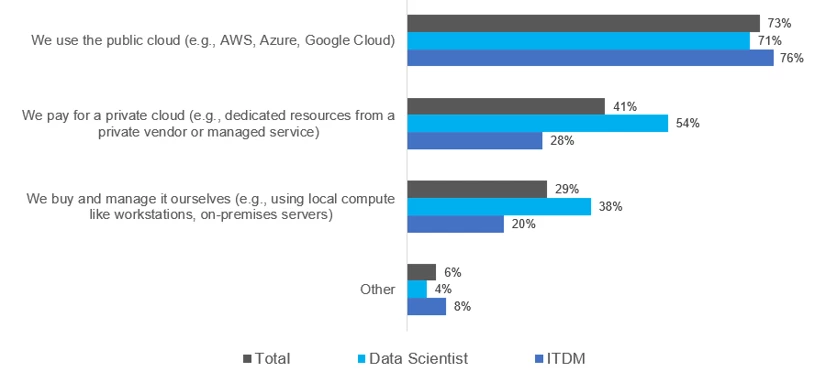
We surveyed around 50 Data Scientists and IT Decision Makers to understand how their teams obtain the necessary compute for workloads and the consideration set used to make these types of decisions. Here are the key highlights: Use of a public cloud is the most popular way to obtain the compute needed to manage AI workloads, though roughly a third of Data Scientists and ITDMs use a combination of sources. Often time, teams consider the type of work they’re supporting when making decisions about which sources to rely on. Depending on the size of the workload or sensitivity of the data, they may choose one option may over another. Data Scientists and ITDMs admit that cost, flexibility, scalability, security, and performance are important factors.What do you think of the results and how does your team secure the compute resources needed to handle AI workloads?
Already have an account? Login
Enter your E-mail address. We'll send you an e-mail with instructions to reset your password.