NEW - ISO 27001 Certification and ONNX and Triton Blueprints for Accelerated Inference
Share insights, seek advice, or simply connect with fellow members on topics that matter to you.
Recently active
AI Studio 101 (Watch the Recording)What is AI Studio? - Discover key features and capabilities to power your AI projects Getting Started on AI Studio - Follow along with our download experience, first sign-on process, and platform orientation Setting up your first project - Learn practical tips, tricks, and what to anticipate as you begin building
Ready to dive into the HP AI Studio & NVIDIA Developer Challenge? The process is straightforward: after registering on Devpost, you'll receive an activation email from AI Studio with download links. Simply click the activation link, sign in with your HPID (or create one), download the installer for your platform, and follow the setup wizard. The first team member to sign in receives admin privileges and can invite others through the team settings.Once set up, you can create projects, define workspaces using NVIDIA NGC GPU-optimized pre-trained models, and start coding in notebooks. AI Studio brings together everything you need—data, people, and compute—in one powerful environment optimized for AI development. Be sure to check out the base images and GPU resources available to maximize your project's performance during the challenge! Have questions? Drop a comment below!Learn more about AI Studio here and see how Z by HP powers Data Science & AI Solutions.
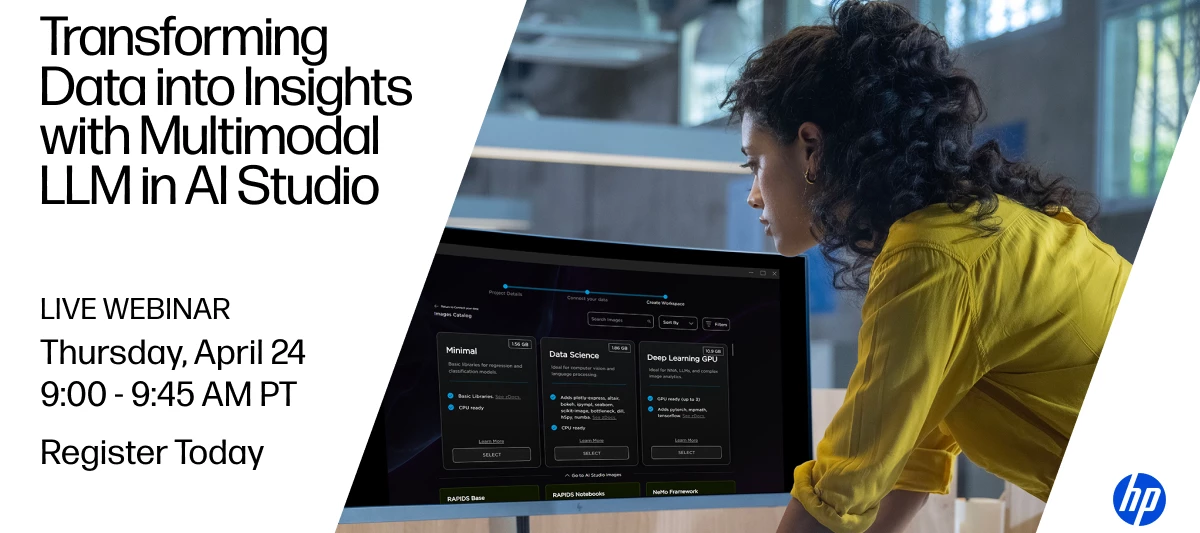
Working with diverse medical data like text, images, and audio can be challenging when trying to extract meaningful insights. In this webinar, Javier Hernandez, a Data Engineer, and AI researcher will share how multimodal large language models in HP’s AI Studio can help you integrate and analyze these different data formats more effectively.We’ll discuss how to create a real-world application, its challenges, and how HP’s AI Studio can transform medical research and diagnostics. Whether you’re new to multimodal analysis or looking to enhance your current methods, this session will provide valuable strategies for making better data-driven decisions.Join us to learn how to supercharge your workflows. Space is limited - register now to secure your spot!Topic: Transforming Data into Insights with Multimodal LLMs in AI StudioSpeaker: Javier Hernandez, Data Engineer & AI ResearcherDate & time: April 24th | 9:00-9:45am PT Register here: https://reinvent.hp.com/ai-studio-apr24
You can find the code for the project and README in this public repository: https://github.com/HPInc/aistudio-samples/tree/main/deep-learning-in-ais/image_generation_deepseek_janus_pro
AI Studio Platform Walkthrough: From Project Creation to Model Deployment This video covers essential features of AI Studio:Project Creation: Learn how to set up new projects with customized descriptions, tags, and privacy settings. We'll show you how to seamlessly connect to GitHub repositories for efficient code management.Asset Management: Discover how to upload, organize, and leverage different assets within your projects, making data management intuitive and efficient.NVIDIA NGC Model Integration: Explore the NGC catalog and see how easily you can search for and incorporate NVIDIA's GPU-optimized pre-trained models into your workflow, accelerating your development process.Workspace Configuration: Master the creation of custom workspaces tailored to your project's computational needs, ensuring you have the right resources for your specific tasks.Notebook Development: Experience the powerful coding environment with Jupyter notebooks, complete with pre-configured dependencies and se
AI Studio is a secure, containerized development environment that enables easy team collaboration. This document outlines the requirements for the AI Studio platform.
AI Studio workspaces streamline the entire AI/ML development lifecycle, from initial experimentation to final deployment:• Quickly spin up an environment with the necessary libraries• Collaborate effortlessly with team members, sharing notebooks and resources in real time• Utilize the containerized environment to develop locally and maintain control of sensitive dataThis document walks through the process of creating AI Studio Workspaces.
Dear Community Members, We are delighted to invite you to an insightful talk presented by our talented student team.How will Neural Processing Units (NPUs) redefine the landscape of local AI? Our student team has delved into this question by conducting comprehensive performance comparisons of CPUs, GPUs, and NPUs on Z by HP mobile workstations. Their research focuses on a practical application: leveraging Large Language Models (LLMs) and Retrieval Augmented Generation (RAG) for efficient document interaction.During this session, you will gain valuable insights into:- Performance Comparisons: Detailed findings on processing speed across CPUs, GPUs, and NPUs.- Energy Efficiency: Real-world data on the energy consumption of these processing units.- Local AI Capabilities: A practical demonstration of LLMs and RAG for document interaction on mobile workstations.- Future of Computing: An engaging discussion on the potential of NPUs and the future of local AI. Event Details:Date: April 4th,
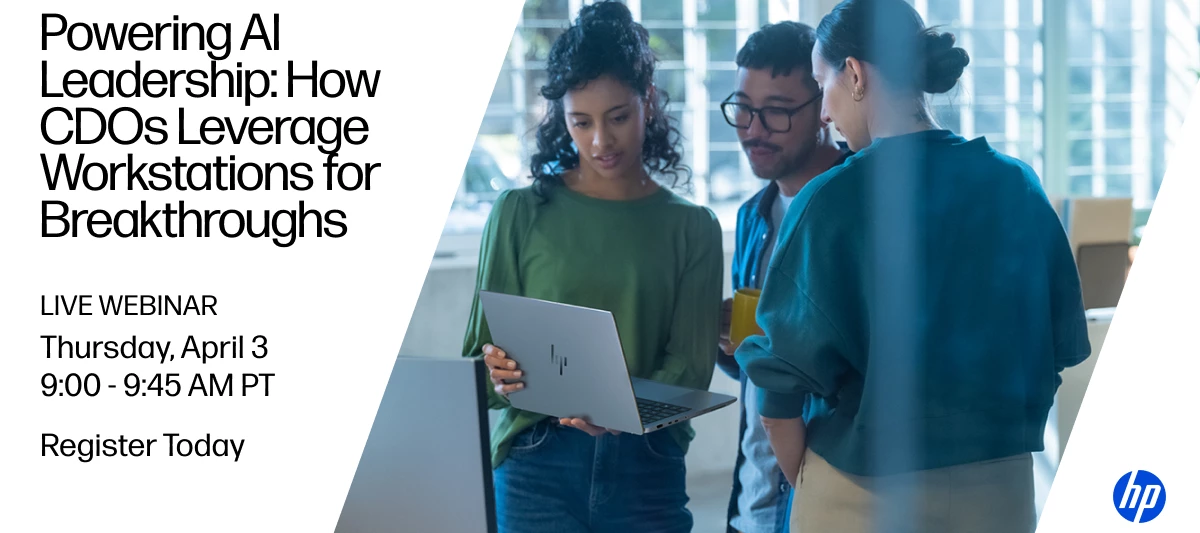
Join us for an exclusive conversation with Firat Gonen, Chief Data Officer at Figopara, as he shares how today’s data leaders are blending strategic vision with hands-on technical work to deliver real business results.Firat will walk us through his approach to building a strong data strategy, staying technically involved, and using high-performance workstations to support data-driven decision-making—especially when cloud isn’t always an option.🗓️ Date: April 3rd⏰ Time: 9:00 – 10:00am PST🎙️ Hosted by: Matthew Ireland, Senior Sales Manager – AI Software and Solutions at HP🔗 Register here: https://reinvent.hp.com/firesidechat-Apr3Here’s what you’ll get out of it:How modern data leaders balance executive goals with technical execution Why on-prem HP Z workstations are essential when cloud use is restricted Real ways to apply GenAI, LLMs, and ML models for business impact How the right hardware can unlock the full potential of your AI and data science work
A recent video post by Akash James of SparkCognition shows how he was able to get the GPU he needed to work on his multi-modal LLM called VERsatile ONline Intelligent Cognitive Agent (VERONICA) by accessing compute he owned in India from the Himalayas. Join the Z by HP Boost webinar Oct 4th @ 9 am PST to hear how Akash is accessing his GPU remotely to create AI.
I am looking to run some testing on a local ollama model in AI Studio. However, every time I open AI Studio, I have to redownload ollama and pull llama3 to use from my notebook. Any suggestion for how to save that download (done from terminal) so that it is already loaded when I open AI Studio?
I'm a Researcher, We want to work on Artificial intelligence, Deep learning and Machine Learning algorithms on healthcare databases. We have a budget of about 30,00,000/- Lakhs Indian rupees to spend. Please suggest a Workstation and an NVIDIA GPU under this budget.
HP & NVIDIA AI Influencer Event at NVIDIA GTC 2025When: March 19, 2025 | 7:30 PM – 9:30 PM PDTWhere: Loft Bar & Bistro - Dining Room, San Jose, CAEngage with top AI influencers Discuss cutting-edge AI trends Expand your industry connectionsSecure your spot! https://register.nvidia.com/flow/nvidia/gtcs25/se73345/form/rsvp
AI is evolving fast, and with all the hype, it’s easy to lose sight of what really matters. In a recent conversation, Thomas H. Davenport and Randy Bean broke down five key AI trends that will shape the year ahead—helping leaders cut through the noise and focus on what’s actually changing the game.n this discussion, they cover:Agentic AI: Hype vs. Reality – How to navigate the excitement and actual impact. AI ROI Matters – Why businesses need to track real value, not just trends. Data-Driven Culture Struggles – The persistent roadblocks to making data central to decision-making. Unstructured Data Challenges – Why tackling messy data is more important than ever. Evolving AI Leadership – How roles and reporting structures are shifting in the AI era.Drawing from their latest MIT Sloan Management Review article, these experts dive into how agentic AI and large language models are reshaping business in 2025. They explore how data-driven decision-making is changing the way companies operate
Imagine teaching a robot to boil water. It might first search for a pot, fill it with water, then place it on the stove. But what if it mistakenly turns on the microwave instead of the stove? Traditional AI agents often struggle to recover from such errors, leading to cascading failures. This is the problem Agent-R—a novel framework for training self-reflective language model agents—aims to solve.In this article, we’ll unpack the theoretical backbone of Agent-R by focusing on how this framework redefines error recovery in AI.Why Error Recovery Matters in Interactive EnvironmentsMost AI agents learn by mimicking expert trajectories (e.g., perfect step-by-step guides). But real-world tasks are messy. Errors are inevitable, and waiting until the end of a task to correct them is like letting a typo in a sentence propagate into a garbled paragraph.The Core Challenge: Timely InterventionProblem: In multi-step tasks (e.g., crafting items in Minecraft or navigating a virtual lab), errors early
Multi-agent systems have become increasingly important in solving complex problems through distributed intelligence and collaboration. However, coordinating multiple agents effectively remains a significant challenge, particularly in the field of reinforcement learning. In this article, we'll explore a novel approach called Shared Recurrent Memory Transformer (SRMT) that aims to enhance coordination in decentralized multi-agent systems.The Challenge of Multi-Agent CoordinationImagine a group of robots trying to navigate through a crowded warehouse. Each robot has its own goal and can only see what's immediately around it. How can they work together efficiently without bumping into each other or getting stuck? This is the essence of the multi-agent pathfinding problem.Traditional approaches often struggle with this task, especially when the environment is complex or the number of agents is large. They may rely on centralized control, which doesn't scale well, or on explicit communicatio
DeepSeek is an open source, open weight set of pre-trained models people can use for inference through the DeepSeek web app on chat.deepseek.com by agreeing to their terms of service and privacy policies or training by downloading the models. Similarly to OpenAI, the privacy policy lets users know that data and logic shared is collected and fair game for the company to retain and retrain their models, so be careful what you share. However, since DeepSeek is open source, AI creators can download models locally and set-up to use for local AI development and retraining of weights to efficiently create and tune focused models for optimized functions and tasks. Check out DeepSeek’s open models on Github at github.com/deepseek-ai.Mike Le Galloudec at Oakland shares a great 6 min review and will be sharing how to get R1 running locally on private systems.Are you doing something similar? Share how you’re getting DeepSeek models running locally!
A research paper by Ali Behrouz, Peilin Zhong and Vahab Mirrokni from Google Research introduce a groundbreaking neural network module that addresses the limitations of current models in handling long term dependencies. This work is a significant leap forward in the design of memory augmented architectures, offering theoretical and practical advancements in sequence modeling. Below we explore the theoretical underpinnings, technical innovations and experimental results of this advanced neural network module.The Challenge of Long-Term DependenciesModern neural architectures like Transformers and recurrent neural networks (RNNs) have revolutionized sequence modeling. However, they face some challenges:Transformers: While effective at capturing short term dependencies through attention mechanisms, they are computationally expensive for long sequences due to quadratic complexity in context length. Their context window limits their ability to model long term dependencies Recurrent Models
Cre[AI]tion, co-founded by Z by HP Ambassador Nik Dorndorf, is transforming the design landscape by connecting creators with AI tools that enhance creativity and streamline workflows. Acting as a "digital muse," Cre[AI]tion helps designers access advanced AI models and develop custom solutions tailored to their needs.With the power of Z by HP workstations, they’re driving innovation—accelerating model training, optimizing creative processes, and enabling groundbreaking projects. These high-performance workstations are a key part of how Cre[AI]tion supports creators in pushing the boundaries of what’s possible.Explore their case study to see how they’re shaping the future of design.
Image generated using CopilotArtificial intelligence (AI) systems are becoming increasingly sophisticated, capable of generalizing across tasks and domains. However, this complexity makes them harder to understand, raising concerns about their trustworthiness and safety. Mechanistic interpretability offers a promising solution by reverse-engineering neural networks to uncover how they process information internally. Just as neuroscience advanced our understanding of the brain by studying internal cognitive processes, mechanistic interpretability seeks to move beyond black-box methods to provide precise, causal explanations of AI behavior.This article explores the principles, methods, and implications of mechanistic interpretability. By examining its core concepts, such as features, circuits, and hypotheses like superposition and linear representation, we aim to shed light on how this field can contribute to AI safety while addressing the challenges it faces.Mechanistic interpretabilit
Google announced its Willow project with amazing claims on performance capabilities.
We’re excited to recognize Ayon Roy as our latest Z by HP Ambassador of the Month! 🎉As an Executive Data Scientist at NielsenIQ, Ayon is making waves in sustainable innovation with his project, Greenscape AI. This AI-powered framework for urban forestry is reshaping how cities approach sustainability. By integrating satellite imagery and drone footage, Greenscape AI maps tree species, analyzes spatial distributions, and creates high-resolution urban forestry maps. These tools help optimize urban green space management, contribute to climate action, and promote ecosystem preservation.Ayon credits the ZBook Studio G10 and Z8 Fury G5 for making this ambitious project possible. With early access to Z by HP Boost, he leveraged the immense processing power of the Z8 Fury remotely from his Studio G10 laptop. This seamless integration of advanced hardware enabled efficient model training and deployment, accelerating his workflow and bringing Greenscape AI to life.Featured Projects:Greenscape
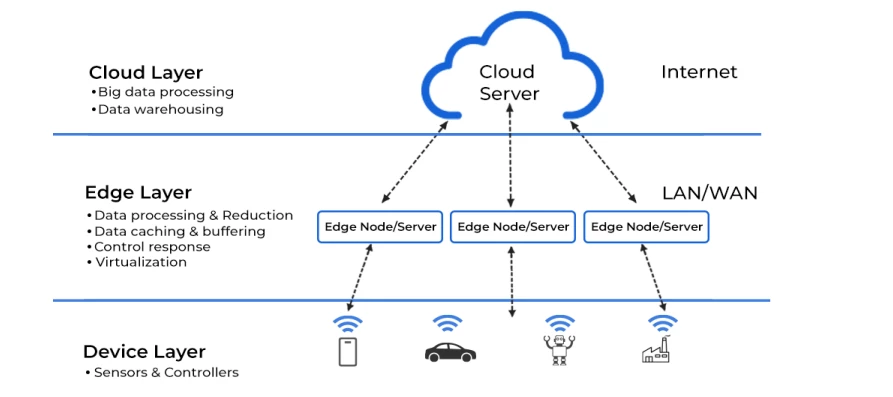
A recent paper titled “Edge computing and AI-driven intelligent traffic monitoring and optimization” explores how edge computing can be used to decentralize AI compute by processing data near IoT devices and vehicles to reduce latency and cloud dependency. The paper finds that edge computing using SLAM technology adequately places compute and storage closer to data sources and end users to enable faster data processing and response times of AI workloads for real-time traffic management, autonomous driving, and V2X communication. Top five take-aways:1. Bring compute close to the data source: Edge computing places processing power closer to data sources (e.g., IoT devices, vehicles), enabling real-time data analysis and response. This reduces latency, enhances reliability, and alleviates bandwidth constraints, particularly crucial for traffic management and autonomous driving during peak periods.2. Decentralize to improve system efficiency and economy of resource you own:By decentralizi
Really great article from Anthropic with the announcement of MCPhttps://www.anthropic.com/news/model-context-protocolAnthropic has unveiled an exciting new initiative: the Model Context Protocol (MCP). This open-source standard simplifies the connection between AI assistants and various data sources, making integration seamless for developers. MCP includes developer tools, local server support within Claude Desktop applications, and pre-configured servers for popular platforms like Google Drive and GitHub. Notably, companies such as Block and Apollo are already leveraging MCP to enhance their AI capabilities.A standout feature of MCP is its remarkable flexibility; it is designed to connect with data sources that may not even exist yet. Developers can easily get started with quickstart guides and open-source resources provided by Anthropic. This initiative aims to break down the barriers that have traditionally isolated AI models from essential data, facilitating a more interconnected a
Already have an account? Login
Enter your E-mail address. We'll send you an e-mail with instructions to reset your password.







![rethinking creativity: cre[ai]tion x Z by HP](https://uploads-us-west-2.insided.com/hp-en/attachment/379755ca-2f29-47e4-9cb4-54baa9b2d85d_thumb.png "rethinking creativity: cre[ai]tion x Z by HP")